
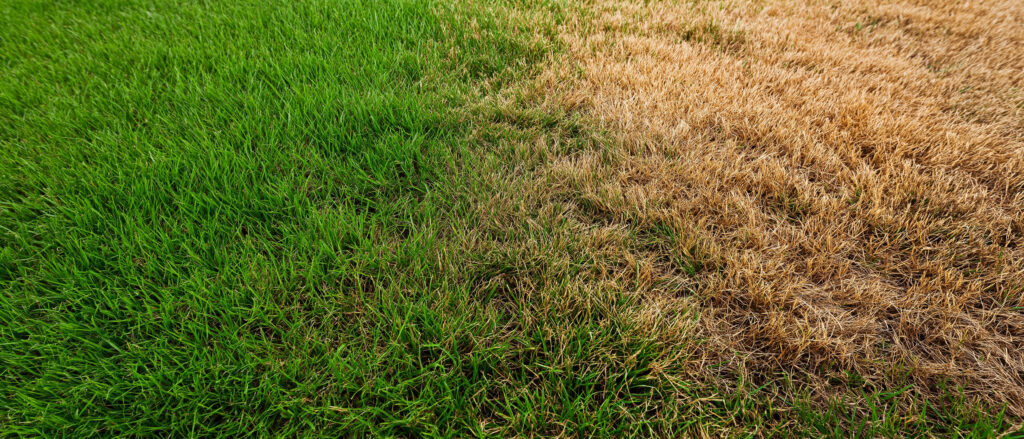
By late summer, commercial turf in Central Kentucky may look thin, brown, or damaged. It can be difficult to determine why.
Heat, drought, irrigation problems, turf diseases, white grubs, and fall armyworms can produce similar symptoms. However, they require very different responses. Treating the wrong problem can waste time and allow the actual damage to get worse.
Here are several signs that can help property managers understand what may be affecting their turf.
Start With the Pattern of Damage
Before assuming insects are responsible, look closely at where and how the damage appears.
Consider:
- Did the turf decline gradually or almost overnight?
- Is the damage limited to one irrigation zone?
- Does it follow sidewalks, pavement, or sunny areas?
- Can the turf be pulled up easily?
- Are birds or other animals feeding in the area?
- Are caterpillars or white larvae visible?
The pattern, timing, soil moisture, root condition, and recent weather can all provide useful clues.
Signs of Summer Heat and Drought Stress
Central Kentucky’s cool-season turf, including tall fescue and Kentucky bluegrass, naturally struggles during hot summer weather. Growth slows, roots become stressed, and turf may turn bluish-gray, tan, or brown.
Signs of heat or drought stress may include:
- Footprints that remain visible after someone walks across the turf
- Brown areas near sidewalks, curbs, and parking lots
- Turf that feels dry but remains firmly rooted
- Damage that follows sunny areas or missed irrigation coverage
- Gradual browning during an extended hot or dry period
Brown turf is not always dead. Cool-season grass can enter drought dormancy to conserve water. However, prolonged drought, heavy traffic, or repeated mowing during severe stress can cause permanent thinning.
Irrigation should be checked before assuming the entire property simply needs more water. A broken head, clogged nozzle, poor pressure, or incorrect controller setting may leave one area dry while another becomes oversaturated.
Signs of White Grub Damage
White grubs are beetle larvae that feed below the soil surface. Their feeding damages turf roots, limiting the plant’s ability to absorb water and nutrients.
Grub damage often becomes more noticeable in late summer and early fall, when heat and dry conditions add stress to already weakened turf.
Possible signs include:
- Turf that wilts even when nearby areas remain green
- Irregular brown patches
- Grass that lifts easily like loose carpet
- Few healthy roots beneath the damaged area
- C-shaped white larvae in the soil
- Birds, skunks, or other animals digging for food
Animal activity alone does not confirm a grub problem. The best way to identify root damage is to inspect beneath the affected turf.
Because drought and disease can also cause browning, treatment should not be based on color alone.
Signs of Fall Armyworm Damage
Fall armyworms are caterpillars that can move into Kentucky during late summer. In outbreak years, they can damage large turf areas quickly by feeding on grass blades.
Unlike gradual summer stress, armyworm damage may appear suddenly.
Watch for:
- Turf that looks scalped or closely mowed
- Ragged or chewed grass blades
- Damage spreading noticeably over a short period
- Visible caterpillars in the turf or thatch
- Increased bird activity
- Healthy roots beneath damaged foliage
The speed of the damage is often an important clue. Drought stress typically develops over time, while a large armyworm population may remove green leaf tissue within days.
Prompt identification matters because armyworm treatment is most effective while larvae are active and damage is still progressing.
Could It Be Disease or an Irrigation Problem?
Insects are not the only late-summer concern.
Brown patch is common in Central Kentucky tall fescue during warm, humid weather. It primarily damages turf leaves and may create circular or irregular brown areas. Nighttime irrigation and long periods of leaf wetness can increase disease pressure.
Irrigation problems can also create defined dry arcs, brown zones, soggy areas, runoff, or uneven turf color.
Other possible causes include:
- Mowing too low
- Dull mower blades
- Soil compaction
- Excessive or poorly timed watering
- Herbicide or fertilizer injury
- Shade and tree-root competition
- Repeated traffic
- Summer patch or other turf diseases
This is why a professional inspection is often more effective than treating based on appearance alone.
What Property Managers Should Do First
When sudden or unusual turf damage appears, document what is happening before making changes.
Take note of:
- When the damage first appeared
- Whether it is spreading
- Recent rainfall and irrigation activity
- Recent mowing or applications
- The condition of the roots and soil
- Any visible insects or feeding damage
- Whether nearby areas are affected
Avoid immediately increasing irrigation across the entire property. If the problem is disease, poor drainage, or uneven coverage, additional water may make conditions worse.
Plan for Fall Recovery
Even after the cause is corrected, damaged turf may not recover fully on its own.
Late summer is the time to evaluate whether affected areas need:
- Core aeration
- Overseeding
- Soil or compaction correction
- Irrigation adjustments
- Weed management
- A broader turf renovation plan
For cool-season turf in Central Kentucky, late summer through early fall is the primary recovery window. Planning early helps ensure seeding, irrigation, and weed-control timing work together.
Protect Your Property’s Turf Before Damage Spreads
Brown or thinning turf can result from insects, heat, disease, irrigation problems, or several stresses occurring at once. The sooner the cause is identified, the easier it is to protect the remaining turf and prepare damaged areas for fall recovery.
HLM Landscape Services helps Central Kentucky property managers evaluate turf health, irrigation performance, pest activity, and seasonal renovation needs. Schedule a property assessment to develop a plan based on what your landscape is actually experiencing.